
Who was Captain Simeon Potter?
Most famous among the names of the old sea captains of Bristol is that of Simeon Potter. For almost half a century Potter was the most conspicuous figure in the town in which he was born. He was also one of the influential men in the Colony and State of Rhode Island for a large part of that time.
Simeon Potter was born in Bristol in the year 1720. His father was not a man of fortune and the boy’s education was almost entirely neglected.

It was not until the letters of Father Fauque (which follow the chapter on Simeon Potter in this book) had been brought to light that we were able to see him as he really was, a slight man. Possibly his great wealth rather than an overpowering personality may have been the cause of his large influence. His fortune was estimated at a quarter of a million dollars, which was an enormous sum for those days.
I love with all my heart
The independent part.
To obey the Parliament
My conscience won’t consent.
I never can abide
To fight on England’s side.
I pray that God may bless
The great and Grand Congress.
This is my mind and heart
Though none should take my part
The man that’s called a Tory
To plague is all my glory.
How righteous is the cause
To keep the Congress laws!
To fight against the King
Bright Liberty will bring.
Lord North and England’s King
I hope that they will swing.
Of this opinion I
Resolve to live and die
That the Assessors make enquiry and make report to the town at the adjournment of the meeting, what part of Colonel Potter’s taxes remain unpaid, and that Mr. Smith, the collector, be desired to apply to the Assessors of the town of Swansea to know at what time said Potter began to pay taxes in said town, and what part of his personal estate has been rated from time to time in said town.
Although he still retained his household in Bristol he had taken up his residence in Swansea, where the rate of taxation was considerably less than that of Bristol. In that Massachusetts town he continued, nominally, to reside for the rest of his life. Notwithstanding his residence in another State he still continued a member of Saint Michael’s Church. In 1792 a vote of the Vestry was passed, thanking him for painting the church edifice, and for other benefactions, and in 1799 he presented a bell (with a French inscription) to the parish. His name headed the list of vestrymen from 1793 until his death. He died, at the age of eighty-six, February 20, 1806, leaving no children. His estate was by will divided among his nine sisters and their descendants. All the beneficiaries did not fare alike. He had his favorites and his strong prejudices. As is almost always the case popular estimate had exaggerated the value of his property. Instead of a quarter of a million, less than half that amount was divided among his heirs. The inventory showed that he had made a great many “wildcat” investments.
From his house on Thames Street the old captain was borne to his last resting place in the burying-ground upon the Common.It was the most impressive funeral the town had witnessed. All the people turned out to see the long procession, and to take part in it. The privateering exploits of his early life were again retold, the innumerable legal battles of his later days were again recounted. Full of strife and tumult were the centuries in which his life had been passed, stormy and passionate his own career had been. He was perhaps the last, he was certainly the most successful, of the old sea captains who, as English subjects, had sailed forth from Narragansett Bay to make war as privateersmen upon the foes of Great Britain. But among those who followed his corpse to its final resting place were men who in less than a decade were to sail out from Bristol harbor in a little private armed vessel whose success as a privateer was to surpass his wildest imaginings, a vessel that was to collect from English merchants a tribute many times exceeding that which he had exacted from the enemies of England. The story of that vessel will be told in the last chapter of this book.
Simeon Potter
Potter's Wealth
Chief Field Officer of Bristol County
Potter's Boat Load
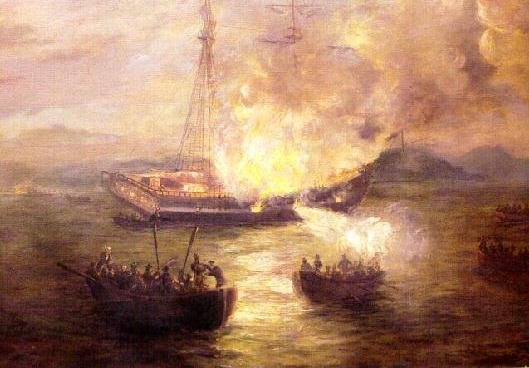
In 1770, Potter also had a large dwelling house, a distillery, a store, and a wharf in Providence (on the west side of Main Street and north of Power’s Lane) [Chace Papers, box 1, f 18]. Potter’s Providence distillery was a few houses south of the Sabin Tavern. Potter may or may not have been in Providence when John Brown laid his plans to attack the Gaspee. At any rate; Potter left from Bristol — not from Providence — on the night in question with a boatload of men from Bristol, with the expressed purpose of meeting the boats from Providence to join together in the attack.
Text taken from GaspeeVirtual Archives.